


Some people love the idea of popping a pill that solves all of their problems. Others don’t want to live in a world where we are ingesting 40+ pills a day in order to stay healthy.
For the past 5.5 years we’ve been developing neurostimulation technologies to enhance the Neural Function of Sleep. We’ve always kept an eye on what is happening in the pharmaceutical space, and what pharmaceuticals could offer in improving the Neural Function of Sleep, and where we’d stand as an alternative.
Though pharmaceutical interventions have improved in recent years with the latest pharmaceutical solutions, such as Belsomra, becoming significantly better at maintaining true restorative sleep while decreasing sleep onset, there still are no pharmaceuticals which increase Neural Function of Sleep.
I came across two conversations last week which brought this idea to the forefront.
In the first, a sleep therapist was arguing that we shouldn’t treat a sleep apnea pill as the “holy grail” because with a drug that reduces apnea events by 50%, he’d still prescribe CPAP.
Minutes later I read a post by a neuroscientist and therapist who uses magnetic neuromodulation (rTMS) to treat PTSD, and he reported he is seeing Ozempic type weight loss results from this treatment, which echoes how Ozempic was discovered as a weight loss treatment itself.
These two stories provide the perfect juxtaposition to help me further understand our position in the world of health.
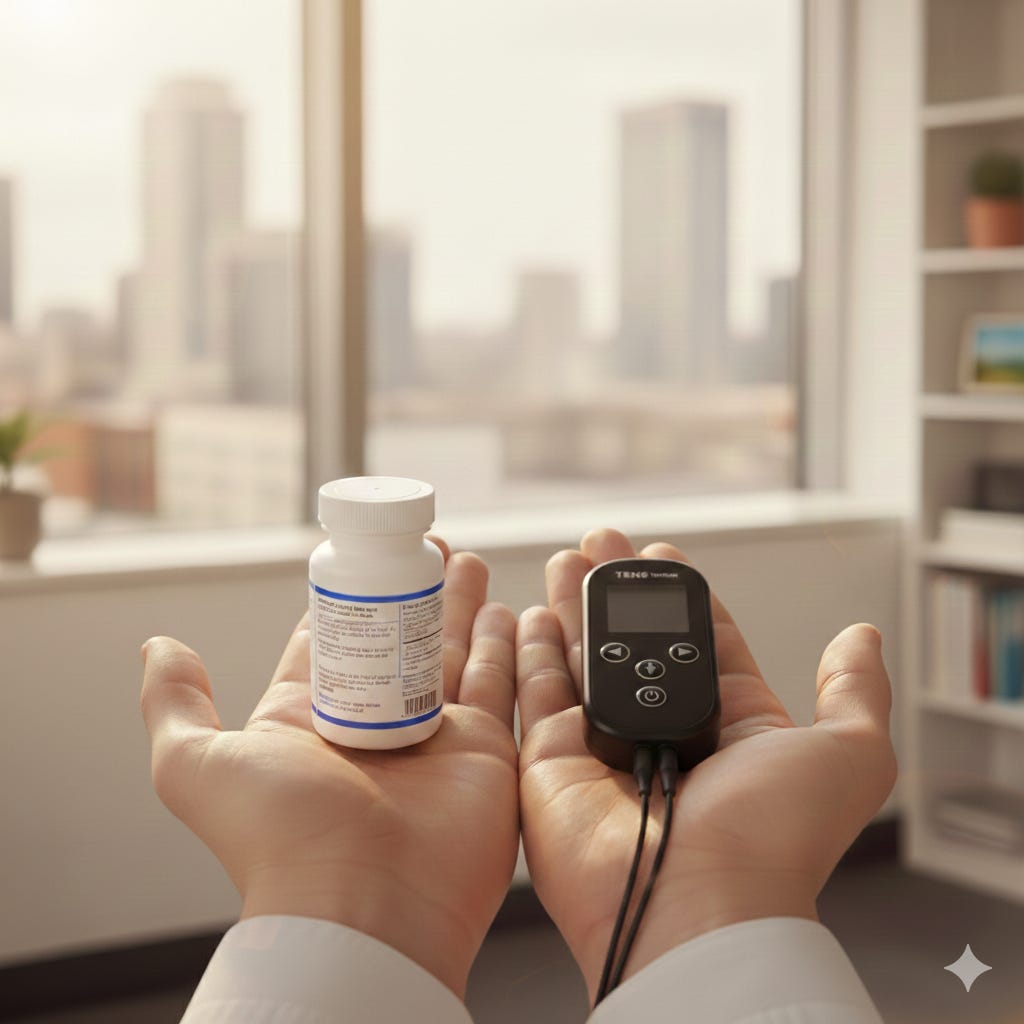
Device or Molecule?
First, my thoughts on an Apnea pill. In this context, I completely disagree with the original post. CPAP is an invasive and blunt instrument in preventing apnea events. It is not only inconvenient for the wearer, it is also disruptive to their partner, difficult to use when travelling, uncomfortable, causes dryness in the nose and throat. Adherence is incredibly low because, for many people, the treatment is worse than the disease.
A pill for sleep apnea, even if it is less effective, is more convenient, has a lower up-front cost and is likely cost even over time (most people don’t realize CPAP masks must be replaced every month and headgear about every 6 months). Not only that, the cost for a person to try an apnea pill is almost nothing, and with home apnea tests, the potential to try and measure the response makes treatment more accessible to millions of people.
I’ve not been a fan of CPAP, I have a brother who had CPAP and moved to a mandibular device a few years ago. It was a game-changer for him! The math of how we consider treatments isn’t just “what has the best total efficacy on the disease, but rather efficacy * adherence.
Mandibular devices may not be as “effective” as CPAP, but because people are more likely to continue using them, the mandibular splint should be the go-to solution.
If the apnea pill proves to have similar efficacy to the mandibular splint, and better adherence, it should be the primary treatment, or at least an fast inexpensive trial to see if the patient responds.
So in this case, when convenience and adherence are a significant hurdle to treatment, a simple and inexpensive pill is the preferred solution over a medical device.
The Price of the Persistent Molecule
While a pill for apnea might be better than a mask, a device-based alternative to GLP-1 drugs might be better than a pill.
When you put a molecule into your body, you lose control over it. We saw the “happy accident” of this with Ozempic. A drug designed for insulin also hit the brain and silenced the demand for food and alcohol. But not all accidents are happy. People on these drugs deal with constant nausea, muscle loss, and potential damage to the gallbladder or thyroid.
The current trend in pharma is to make these peptide formulations last longer in the body. We are seeing reports of a once-a-month pill. This is where it gets risky.
In a healthy body, the natural version of GLP1 only has a half-life of two minutes. Your body releases the precise amount only when it is needed. A once-a-month pill means that same molecule is shouting at your system every second of every day for thirty days straight!
Tuning the Engine vs. Adding More Fuel
Neuromodulation offers a different path. Instead of flooding the system, it aims to strengthen the neural pathways the body already uses. You cannot get more power out of a broken engine just by adding more fuel. You have to tune the engine itself so it operates the way it was designed to.
The methods used in PTSD (like rTMS) are not easily accessible yet, but we are at the very beginning of a neurotechnology future. At Affectable Sleep, we are applying this logic to the brain during sleep. We focus on enhancing the Neural Function of Sleep. Research shows this improves memory, clears metabolic waste, and primes the immune system. These are results that current sleep pills simply cannot replicate.
There currently isn’t a pharmaceutical which has results anything similar to what Affectable’s Ultrasleep™ stimulation can accomplish. The stimulation is precise, and adapts to the activity of your brain at each individual moment.
I believe this is one of the most important future directions for either medical devices or pharmaceuticals.
A future where our treatments adapt to our physiology/biology/neurology in real-time to get the utmost benefit tuned to our immediate needs.
But that’s a discussion for another time.
Here at Affectable Sleep, we focus on enhancing the vital processes that happen during sleep that support your brain and body to function on the daily. We’ve spent the last 5 years developing neurotechnology to enhance Sleep’s Neural Function without altering sleep time. Affectable Sleep is pioneering a new type of wearable, that goes beyond harvesting our data and showing us pretty graphs, to directly affecting our biology, physiology, and neurophysiology to improve our health in real-time.
Learn more at our website and follow our thinking and research on Linkedin